
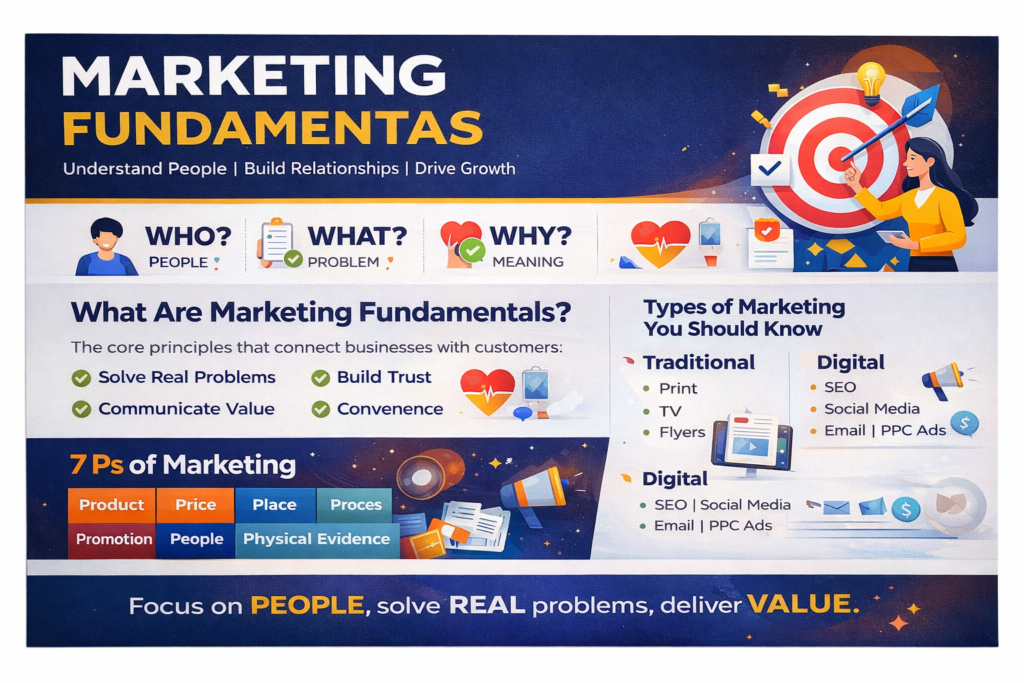
Marketing fundamentals are the foundation of every successful business strategy. Marketing isn’t magic—it’s about understanding people, solving real problems, and building meaningful relationships that last.
In today’s hyper-competitive world, brands that chase shortcuts often burn out fast. The ones that win? They master the fundamentals.
This guide breaks down marketing fundamentals in a clear, practical, and human way—so you don’t just learn theory, you learn how to apply it. Whether you’re a business owner, marketer, or entrepreneur, this roadmap will help you build a strategy that actually works.
What Are Marketing Fundamentals in Modern Business?
Marketing fundamentals are the core principles that guide how businesses connect with customers. These principles help brands communicate value, build trust, and create long-term relationships.
Think of them as the foundation of a building. Without strong fundamentals, even the flashiest marketing campaigns collapse under pressure.
At its heart, marketing answers three simple questions:
-
Who are you helping?
-
What problem are you solving?
-
Why should people care?
When these answers are clear, everything else becomes easier. In today fast-moving digital landscape, marketing fundamentals also ensure consistency across every touchpoint.
Whether a customer encounters your brand through a social media post, an email, a website, or a sales conversation, the message should feel aligned and intentional. Strong fundamentals help businesses avoid fragmented communication and instead present a clear, unified brand story that audiences can recognise and trust over time.
The True Purpose of Marketing
Marketing isn’t about manipulation. It’s about connection.
Its real job is to:
-
Introduce your product or service to the right people
-
Explain how it improves their lives
-
Build trust before asking for action
Good marketing doesn’t interrupt—it invites.
When done right, marketing becomes a bridge between human needs and business solutions. It creates clarity, confidence, and loyalty.
Why Marketing Fundamentals Still Matter Today
Trends change. Platforms evolve. Algorithms shift. Marketing fundamentals matter because they keep your strategy grounded when everything else feels noisy. While tools and platforms come and go, the basics—clear positioning, understanding customer needs, and communicating real value—ensure your message doesn’t get lost. Brands that rely only on trends often struggle to stay consistent, but fundamentals provide a steady framework for smart decision-making.
Strong fundamentals also help you build momentum, not just momentary attention. When your marketing is rooted in trust, relevance, and clarity, growth becomes repeatable instead of accidental. You’re no longer chasing what’s new—you’re choosing what works, and that’s what keeps a brand sustainable in the long run.
But human psychology? That stays remarkably consistent.
People still want:
-
Simplicity
-
Trust
-
Value
-
Relevance
Mastering fundamentals allows your brand to adapt without losing direction. It helps you grow intentionally instead of reacting emotionally to every trend.
Market Research: The Backbone of Smart Marketing
If marketing is a journey, research is your map.
Market research removes guesswork. It tells you what your audience wants, how they behave, and where opportunities exist.
Without research, you’re just guessing—and guessing is expensive.
Why Market Research Matters
-
Helps identify real customer pain points instead of assumed problems
-
Reduces risk before launching products, campaigns, or offers
-
Reveals buying motivations, objections, and decision triggers
-
Highlights market gaps and untapped opportunities
-
Supports data-driven positioning and messaging
What Good Market Research Enables
-
Better audience segmentation and targeting
-
More relevant content and campaigns
-
Stronger product–market fit
-
Smarter pricing and packaging decisions
Primary vs Secondary Research
Primary Research
This is firsthand data collected directly from your audience:
-
Surveys
-
Interviews
-
Feedback forms
-
Focus groups
It gives real-time insights straight from your potential customers.
Secondary Research
This includes existing reports, studies, and industry data. It helps you understand market trends and competitive landscapes.
The smartest brands use both. Secondary research is useful because it provides a broader view of the market without the time and cost of collecting new data. Industry reports, competitor analysis, government data, and published studies help businesses spot patterns, understand benchmarks, and identify gaps or opportunities within their space. It’s often the fastest way to get context before making strategic decisions.
Competitor Analysis: Learn Without Copying
Competitors are teachers—if you study them correctly.
Analyze:
-
Their strengths and weaknesses
-
Their messaging style
-
Their audience engagement
This helps you identify gaps and position your brand differently instead of blending in.
Understanding Industry Trends
Markets evolve constantly. Consumer behavior shifts. Technology advances.
Tracking trends allows you to:
-
Anticipate changes
-
Stay relevant
-
Avoid becoming outdated
Smart brands adapt early, not late.
The 7Ps of Marketing Fundamentals Explained
The 7Ps provide a complete framework for delivering value.
1. Product
Your product is the solution to a problem.
It includes:
-
Features
-
Design
-
Quality
-
Customer experience
A great product solves a real issue and feels intuitive to use.
2. Price
Pricing tells a story.
Is your brand premium, affordable, or value-driven?
Good pricing balances:
-
Profitability
-
Customer perception
-
Market competition
It should feel fair, not forced.
3. Place
This is about availability.
Where can people find you?
-
Online stores
-
Marketplaces
-
Physical locations
Convenience drives conversions.
4. Promotion
Promotion is how people hear your story.
This includes:
-
Ads
-
Social media
-
Content marketing
-
Influencer partnerships
The goal isn’t noise—it’s clarity.
5. People
People represent your brand.
From customer support to sales teams, every interaction shapes perception. Friendly, informed, and empathetic teams build trust instantly.
6. Process
Process ensures consistency.
Smooth systems reduce friction, errors, and frustration—creating a better experience for everyone.
7. Physical Evidence
Visual proof builds confidence:
-
Website design
-
Packaging
-
Branding
-
Store layout
These cues reassure customers they made the right choice.
Types of Marketing You Should Know
Traditional Marketing
Includes:
-
Print ad
-
Flyers
-
Billboard
-
Event
It works well locally and builds personal connections. Traditional marketing is especially effective for brand recall and offline trust, particularly in regional markets and face-to-face interactions.
Digital Marketing
The backbone of modern business.
Includes:
-
Websites
-
Social media
-
Email
-
Paid ads
Digital marketing offers precision, scalability, and measurable results. It allows brands to target specific audiences, track performance in real time, and optimize campaigns quickly for better ROI.
Content Marketing
Focuses on educating before selling.
Includes blogs, videos, guides, podcasts, and case studies. Content marketing builds authority, nurtures trust, and supports every stage of the buyer journey.
Influencer & Referral Marketing
Built on trust and social proof.
By leveraging creators, industry experts, and existing customers, brands can reach new audiences faster while borrowing credibility from trusted voices.
Core Pillars of Digital Marketing
1. Search Engine Optimization (SEO)
SEO helps your content get found organically.
Key elements:
-
Keyword research
-
On-page optimization
-
Quality content
-
Technical structure
SEO builds long-term visibility.
2. Content Marketing
Content builds trust before selling.
Blogs, videos, and guides help your audience learn and engage—without pressure.
3. Social Media Marketing
Social platforms help humanize your brand.
They’re perfect for:
-
Conversations
-
Community building
-
Storytelling
4. Email Marketing
One of the highest ROI channels.
It allows personal, direct communication that nurtures long-term relationships.
5. Paid Advertising (PPC)
PPC offers instant visibility.
When done right, it brings targeted traffic and measurable growth.
6. Influencer & Affiliate Marketing
People trust people.
Partnering with trusted voices expands reach and credibility.
7. Mobile Marketing
Mobile-first experiences are no longer optional.
Fast loading, responsive design, and concise messaging matter more than ever.
8. Conversion Rate Optimization (CRO)
Driving traffic isn’t enough if users don’t take action.
CRO focuses on improving landing pages, forms, CTAs, and user flows to turn visitors into leads or customers.
9. Marketing Automation & CRM Integration
Automation helps scale personalized communication.
From lead nurturing emails to behavior-based follow-ups, it ensures no opportunity slips through the cracks.
10. Analytics & Performance Tracking
Data turns marketing into a growth engine.
Tracking metrics like engagement, conversions, and customer journeys helps refine strategies and prove ROI.
11. Brand & Experience Consistency
Every touchpoint matters.
Consistent messaging, visuals, and tone across channels build recognition, trust, and long-term loyalty.
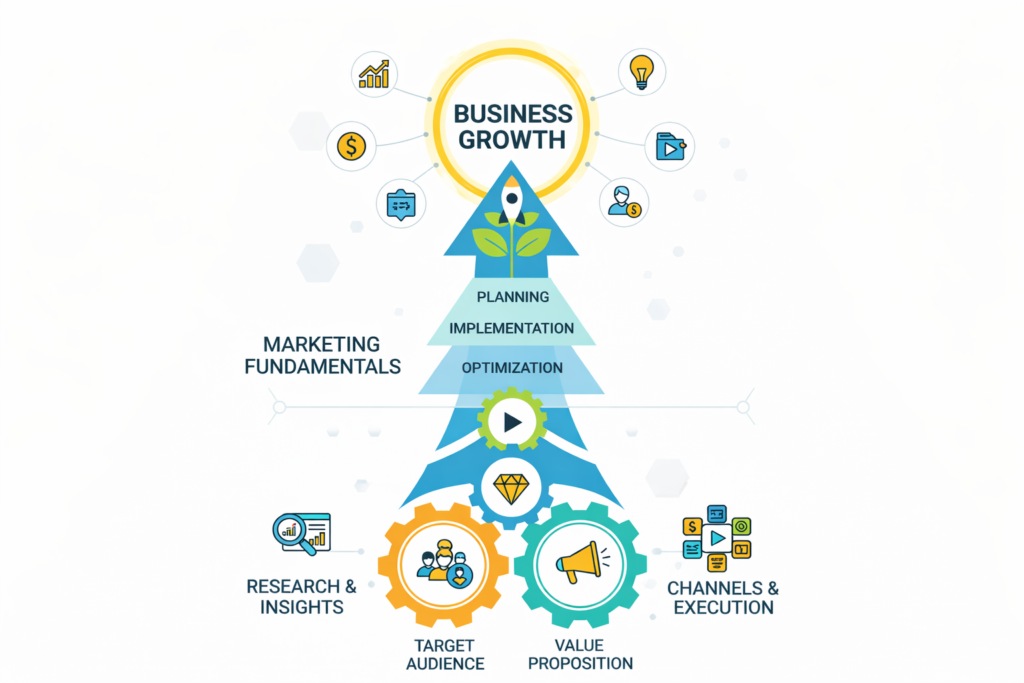
Building a Marketing Strategy Step by Step
-
Set clear, measurable goals
-
Understand your audience deeply
-
Analyze competitors
-
Define your value proposition
-
Choose the right channels
-
Execute consistently
-
Measure and optimize
A strategy isn’t static—it evolves.
Common Marketing Mistakes to Avoid
-
Skipping research
-
Ignoring feedback
-
Chasing trends blindly
-
Focusing only on short-term gains
-
Inconsistent messaging
Avoid these, and you’re already ahead of most brands.
Marketing Books Every Marketer Should Read
-
Influence – Robert Cialdini
-
Contagious – Jonah Berger
-
This Is Marketing – Seth Godin
Each offers timeless lessons that sharpen strategy and mindset.
Turning Fundamentals Into Long-Term Growth
Marketing success doesn’t come from hacks. It comes from consistency, clarity, and customer focus.
Strong fundamentals allow you to:
-
Adapt to change
-
Build trust
-
Scale confidently
When your foundation is solid, growth becomes sustainable—not stressful.
Final Thoughts
Marketing isn’t about quick wins. It’s about building something meaningful over time.
When you understand your audience, communicate with purpose, and stay consistent, results follow naturally.
Strong fundamentals don’t just support growth—they create it.
Marketing success isn’t accidental. It’s designed.
When you master the fundamentals, everything else becomes easier—strategy, messaging, sales, and growth. Focus on people, deliver value, and stay consistent. That’s how brands last.